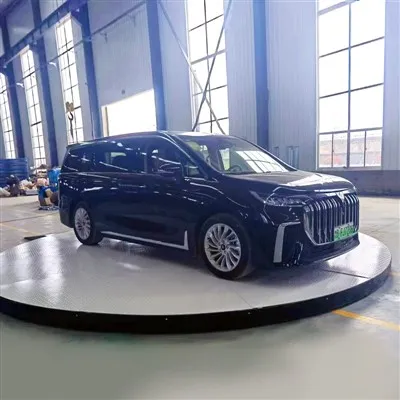
Features and Advantages of a Car Turntable
A car turntable is a rotating platform designed to rotate vehicles, facilitating easier maneuvering in confined spaces. These devices are increasingly utilized in residential driveways, commercial parking areas, and automotive showrooms. Below is a comprehensive overview of their features and advantages
1. Load Capacity and Structural Integrity
High Load Capacity: Car turntables are engineered to support a wide range of vehicles, from compact cars to heavy-duty trucks. For instance, certain commercial models can accommodate weights up to 30 tons, making them suitable for specialized vehicles like fire trucks and construction equipment.
Distributed Load Design: Advanced structural designs, such as honeycomb reinforcements and multi-point hydraulic supports, ensure even weight distribution. This minimizes stress concentrations, reducing the risk of deformation or damage during rotation.
Dynamic Load Adaptability: Incorporation of shock-absorbing components, like hydraulic dampers and rubber buffers, allows the turntable to handle dynamic loads effectively, ensuring stability during vehicle movement.

2. Precision Rotation and Control
Accurate Positioning: Utilizing servo motors coupled with high-precision encoders, car turntables can achieve rotation angle accuracies within ±0.1°, meeting stringent requirements for applications like autonomous vehicle testing.
Versatile Control Modes: Users can operate the turntable through various interfaces, including manual joysticks, touchscreens, or remote controls. Predefined rotation angles (e.g., 90°, 180°, 360°) can be set for quick adjustments.
Adjustable Speed with Smooth Start/Stop: Rotation speeds are typically adjustable between 0.1 to 5 revolutions per minute (rpm), with soft start and stop features to prevent abrupt movements, enhancing safety and comfort.
3. User-Friendly Operation
Intuitive Interfaces: Equipped with industrial-grade touchscreens (10 inches or larger), the control systems support multiple languages and graphical guides, simplifying operation for users.
Self-Diagnostic and Alerts: Integrated sensors monitor critical parameters like motor temperature and platform alignment, providing real-time alerts via visual, auditory, or SMS notifications in case of anomalies.
Modular Maintenance Design: Key components such as motors and hydraulic pumps are designed for easy replacement, allowing maintenance personnel to perform swift part exchanges, minimizing downtime.
4. Comprehensive Safety Features
Physical and Optical Safety Measures: Dual protection systems, including mechanical limit switches and photoelectric sensors, halt operation if obstacles are detected, preventing accidents.
Electrical Safety Systems: Multi-tiered leakage protection and grounding resistance monitoring ensure safe operation even in challenging environments. Components often meet IP67 standards for dust and water resistance.
Data Security and Backup: For models with intelligent control systems, operational data is backed up to cloud servers, facilitating remote diagnostics and maintenance planning.

5. Environmental Adaptability
Compact Structural Design: Optimized layouts, such as the use of planetary reducers, allow for a compact footprint, making installation feasible in space-constrained areas like underground garages.
Resistance to Harsh Conditions: Materials like 316L stainless steel and epoxy coatings provide resilience against corrosive environments, including coastal areas and industrial zones.
Energy Efficiency: Incorporation of permanent magnet synchronous motors and energy recovery systems can reduce overall energy consumption by over 30% compared to traditional models.
6. Customization and Integration
Tailored Platform Designs: Platforms can be customized in various shapes (e.g., trapezoidal, asymmetrical) to accommodate specific vehicle dimensions or operational requirements.
System Integration: Car turntables can be integrated with Automated Guided Vehicle (AGV) systems, Manufacturing Execution Systems (MES), or Building Automation Systems (BAS) for synchronized operations.
Comprehensive Lifecycle Services: Manufacturers often provide end-to-end services, including site assessment, design, installation, and training, with extended warranties and regular maintenance checks to ensure long-term reliability.
7. Overall Benefits
Enhanced Space Utilization: By enabling vehicles to rotate in place, car turntables reduce the need for extensive maneuvering space, allowing for more efficient use of available areas.Pre-Motion 360° Studios
Time Savings: Operations like vehicle turnaround can be completed in as little as 10–15 seconds, significantly faster than traditional methods, which can take several minutes.
Rapid Return on Investment: For facilities with high vehicle throughput, the increased efficiency and space savings can lead to a return on investment within 2–3 years.
In summary, car turntables offer a robust solution for enhancing vehicle maneuverability, optimizing space, and improving operational efficiency across various settings, including residential properties, commercial facilities, and specialized industrial applications.